
Why 50% Off Matters to the Lessee
Home / Why 50% Off Matters to the Lessee
A lessee-focused business case for reducing startup cost, proving field economics, and protecting operating cash flow.
The Lessee Faces the Highest Costs Before Full Value Is Visible
A compressor may be ready to operate, but the lessee must still prepare the location and integrate the package into an active production system. Early deployment costs may include freight, cranes, foundations or supports, piping, electrical work, controls integration, permits, inspections, startup labor, and operator training. During this period, the company may be paying both the lease and the costs required to place the unit into productive service — while gas recovery and production benefits may not begin the same day the compressor arrives. A reduced rental rate softens this overlap.

A company leasing production compressors is not merely adding a monthly rental expense. It is committing capital, personnel, site resources, and operating responsibility to a field deployment that must produce measurable value. The first six months are when the lessee carries the greatest uncertainty and often the heaviest combined cash burden.
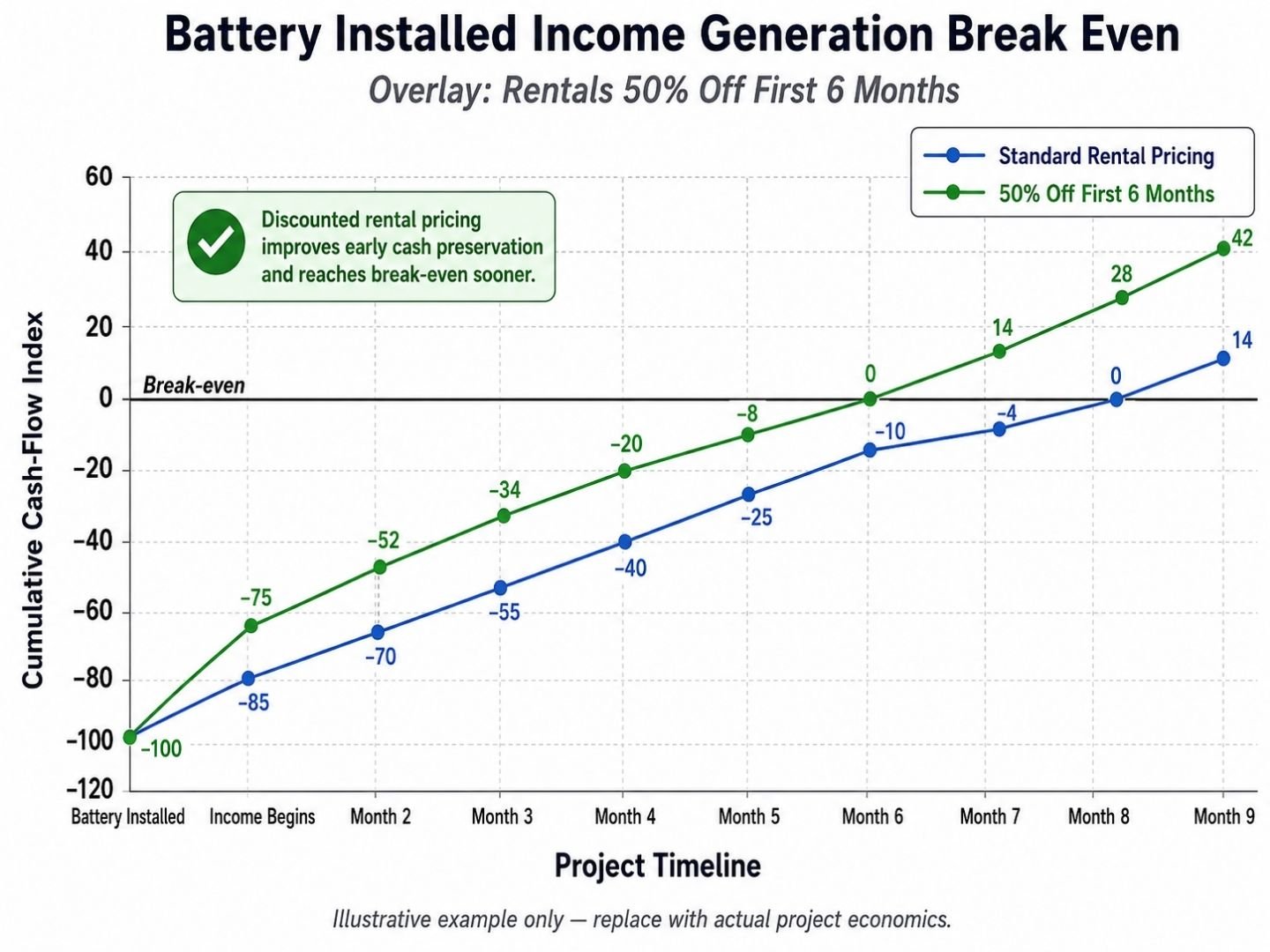
A 50% introductory rental rate gives the lessee time to install and stabilize the equipment, confirm actual gas volumes, measure production and recovery benefits, establish operating procedures, and establish the economics before the full monthly rate begins. The discount matters because it aligns the timing of the rental cost with the timing of the value created by the compressors.
For a firm 36-month lease, the reduced rate is not simply a bargain. It is a practical risk-sharing mechanism that can improve project approval, preserve working capital, reduce the cost of field validation, and make a larger or faster deployment financially possible.
It Preserves Cash During Mobilization and Commissioning
Cash preserved during the first six months can be used for the field work that actually makes the deployment successful — piping, electrical improvements, liquids handling, site access, spare parts, instrumentation, and other operating requirements. This is particularly important when multiple units are deployed: a discount that appears modest on one compressor can become a meaningful source of working capital across a fleet.
Illustrative Savings at a $5,250 Standard Monthly Rate
| Units Leased | Standard Six-Month Rent | Discounted Six-Month Rent | Cash Preserved |
|---|---|---|---|
| 1 | $31,500 | $15,750 | $15,750 |
| 6 | $189,000 | $94,500 | $94,500 |
| 10 | $315,000 | $157,500 | $157,500 |
| 20 | $630,000 | $315,000 | $315,000 |
The example is illustrative. Actual savings depend on the agreed monthly rate, unit count, and exact commercial terms. The 50% introductory discount applies to the monthly rental rate only — mobilization and commissioning fees are billed separately and are not discounted.
It Gives the Company Time to Commission and Optimize in Its Own Field Conditions
A brochure, performance curve, or prior operating history cannot fully duplicate the lessee’s actual conditions. Six months is long enough to evaluate more than whether a compressor starts and runs — it allows the lessee to observe performance through changing production rates, weather, maintenance intervals, and normal operating events. During the introductory period, the lessee can measure: actual uptime and mechanical availability; gas volume compressed and product recovered; suction-pressure control and production response; reduction in venting, flaring, or lost gas; fuel or electrical consumption; maintenance requirements and service response; performance across heat, rain, freezing weather, and changing field conditions; and net monthly economic benefit after all operating costs.
By the time the lease moves to the standard rate, management should have actual field data rather than assumptions.

It Aligns Rental Expense With the Production Ramp-Up
Production benefits may develop gradually — a tank battery may need adjustments, wells may be brought online in stages, field personnel may need time to optimize set points. Charging the full rental rate immediately can create a mismatch: the lessee pays 100% of the cost before receiving 100% of the expected benefit. The introductory rate narrows that gap.
It Lowers the Financial Risk of Approving a New Deployment
Operations may understand the need for compression, but finance, procurement, environmental, and executive management still need a defensible business case. A six-month discount reduces cash exposure during the highest-cost early months and can make internal approval easier — turning the proposal into a controlled deployment where the reduced introductory cost can be compared against measured gas recovery, avoided production loss, reduced emissions exposure, and improved uptime. This is especially useful when the project wasn’t in the original annual budget or when management wants operating evidence before authorizing a broader rollout.
It Can Improve the Project's Early Cash-on-Cash Return
A compressor that captures saleable gas, prevents shut-in production, or stabilizes low-pressure operations may begin creating value quickly. Reducing rent during the first six months increases the share of that early value retained by the lessee — recovered revenue and avoided losses can begin offsetting the reduced rent, so the equipment begins helping to fund its own operation from early in the 36-month term.
It Can Make a Larger Deployment Possible
A company may recognize that ten compressors would create more operational value than two, but the initial cash requirement can limit the first deployment. A 50% introductory rate can allow the company to install the number of units actually needed rather than beginning with an undersized program. A larger deployment may also improve consistency across locations, simplify training and service, support N+1 planning, and produce enough operating data for a meaningful company-wide evaluation.
It Reduces the Cost of Transitioning Away From the Status Quo
The existing operating approach may be expensive, inefficient, or emissions-intensive, yet changing it still creates organizational risk. The reduced rate lowers the cost of comparing the new fleet against continuing with venting, flaring, temporary rentals, older equipment, or production curtailment — the lessee absorbs the learning and transition period without paying the full long-term rate for its entire duration.
The Discount Matters Only When the Commercial Terms Are Clear
The lessee should examine the complete economic package, not the headline percentage alone. Before signing, the company should confirm: the normal monthly rental rate and the exact discounted rate; the date the six-month period begins (shipment, delivery, installation, or successful commissioning); the month the full rate automatically starts; the firm 36-month lease term and any early-termination obligation; freight, mobilization, commissioning, and demobilization charges; responsibility for site preparation, power, piping, cranes, lubricants, filters, and routine maintenance; performance expectations and the conditions they’re based on; service response and downtime responsibilities; and whether customer-caused delays can consume part of the discounted period.
The strongest structure starts the six-month introductory period when the unit is commissioned and available for its intended service — not while it’s sitting on a truck, awaiting site work, or unable to operate because of unresolved installation issues.
What the Offer Does Not Mean
A 50% introductory rate should not be interpreted to mean the compressor is worth only half its standard rental price. It means the provider is accepting less revenue during the lessee’s highest-risk period in order to support a long-term deployment. For the lessee, the value is not merely a lower invoice — it’s the opportunity to commission, measure, and validate the system while preserving capital and limiting the cost of uncertainty.
The Lessee’s Decision Test: Across the full 36-month term, will the compressors recover enough gas, avoid enough production loss, and deliver enough operating benefit to justify the standard rate — and does the 50% discount on the first six months provide the cash-flow room to commission and optimize the fleet during the highest-cost period? If yes, the discount materially improves the economics of the commitment by concentrating relief in the months when installation and ramp-up costs are heaviest.
Because this is a firm 36-month lease rather than a trial, the company should confirm the standard rate, the full-term commitment, and any early-termination obligations before signing — the introductory period lowers early cost, but it does not shorten or condition the term.
From the lessee’s perspective, a 50% discount for the first six months matters because it places the greatest financial relief at the point of greatest cost and uncertainty. It preserves cash during installation, reduces the cost of field validation, improves early project returns, and gives management time to make decisions based on measured operating results.